
The Vía de los Andes connects churches and spiritual spaces in Santiago, Providencia, Vitacura and Las Condes, promoting reflection, encounter and cultural heritage. It has been an official stage of the Camino de Santiago since 22 September 2025, and it strengthens the connection between Chile and Compostela.
About the Vía
History and aims
A spiritual, cultural and community pilgrimage that unites parishes and institutions, recognised as a Camino de Santiago.
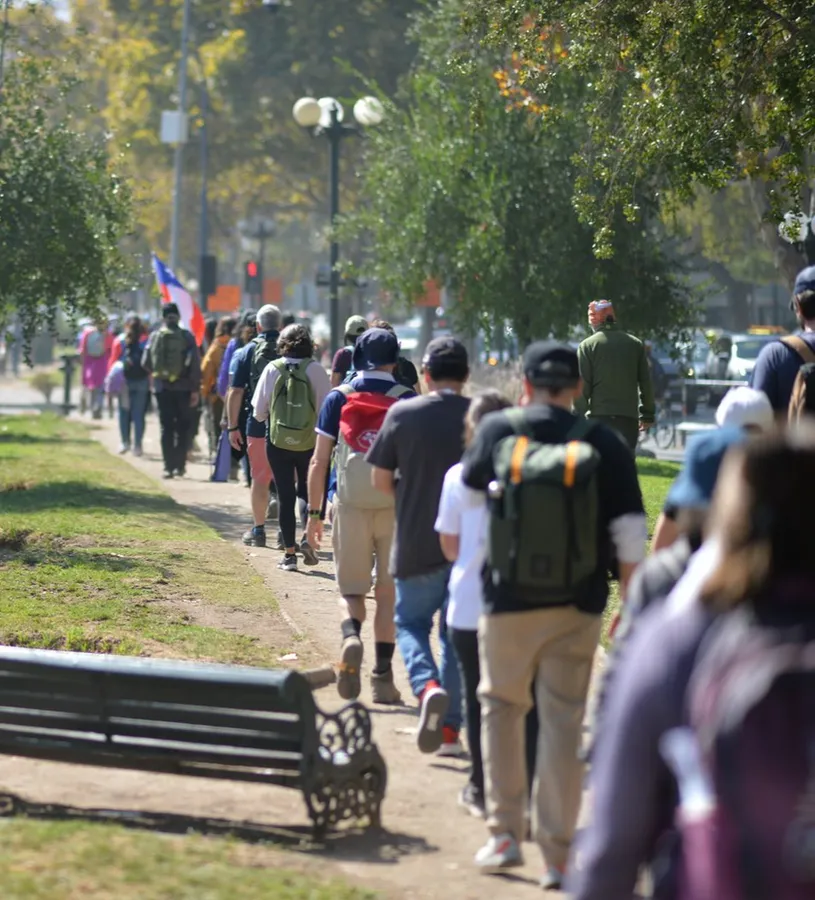
The Vía de los Andes unites parishes and institutions from central Santiago to Las Condes. It passes through sacred and urban spaces in the districts of Santiago, Providencia, Vitacura and Las Condes, which become settings for encounter and contemplation.
It began in 2025, promoted by the Círculo Chileno de Amigos del Camino de Santiago, following an invitation from the Cathedral of Santiago de Compostela to symbolically extend the Camino in Chile. Its 25 km add to what is walked in Spain.
It has 15 points in four districts, from the Cathedral of Santiago to the Benedictine Monastery of Las Condes.
Relics
Treasures of faith that link Santiago de Chile with Rome, Jerusalem and Compostela.
Since the earliest centuries, Christians have made pilgrimages to venerate holy places and the remains of the saints. Relics are not worshipped: they are venerated as signs that bring us closer to those who lived the Gospel and to the places where faith was made manifest.
The Vía de los Andes has the privilege of safeguarding relics that link it with the three great pilgrimage destinations of Christendom: Santiago de Compostela, Jerusalem and Rome: a relic of the Apostle James, a stone from the crypt of the Cathedral of Santiago de Compostela, a stone from the Holy Sepulchre and four bricks from the Holy Doors of Rome.
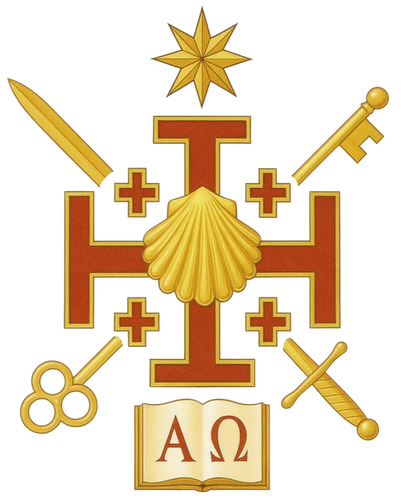
The emblem of the relics, specific to the Vía de los Andes, identifies all the relics gathered here. It brings together the Jerusalem cross, the scallop shell, the keys, the swords, the star and the book with the Alpha and the Omega.
Carry a third-class relic with you
The Church distinguishes three classes of relics:
- First class: remains of a saint's body, such as the relic of the Apostle James.
- Second class: objects that belonged to the saint or were in direct contact with them or with a holy place.
- Third class: objects that have touched a first- or second-class relic.
When the relics are on display, you will be able to touch them with your rosaries, medals, crosses or holy cards. In this way they become third-class relics, as was done in the past with handkerchiefs and cloths: a blessed memento of your pilgrimage that you can take home or give to a loved one or to someone who is ill.
Remember that the Church forbids trading in relics: they are a gift for faith, not an item for sale.
Can the relics of the Vía de los Andes be venerated?
Not yet. They are kept safe and are not on display. The idea is to show them, for now, only on group departures; the Círculo is working out how, and it will be announced once it is defined.
Where the relics are
For now the relics are kept by the Círculo and are not on display in any church. When they are, we will announce it on this page and on our social media.
The bricks from the Holy Doors of Rome
The four bricks are a gift from Pope Francis and come from the Holy Doors of the four major basilicas of Rome, opened during the Extraordinary Jubilee of Mercy (2015–2016). Each one is engraved with the papal coat of arms, the name of Pope Francis, the basilica it belongs to and the cardinal who opened or closed its Holy Door.
Devotion to these bricks is very old: a chronicler of the jubilee of 1423 already recounted that, as soon as the door was knocked down, the faithful rushed to gather its bricks and stones as a sacred memento of the Holy Year. Having them in Chile is a sign of communion with the Pope and with the Church of Rome.
Where do the bricks come from? How a Holy Door works
Each of the four major basilicas of Rome has a Holy Door, which is opened only during Holy Years or Jubilees. Passing through it is a sign of conversion and of passage towards God's mercy.
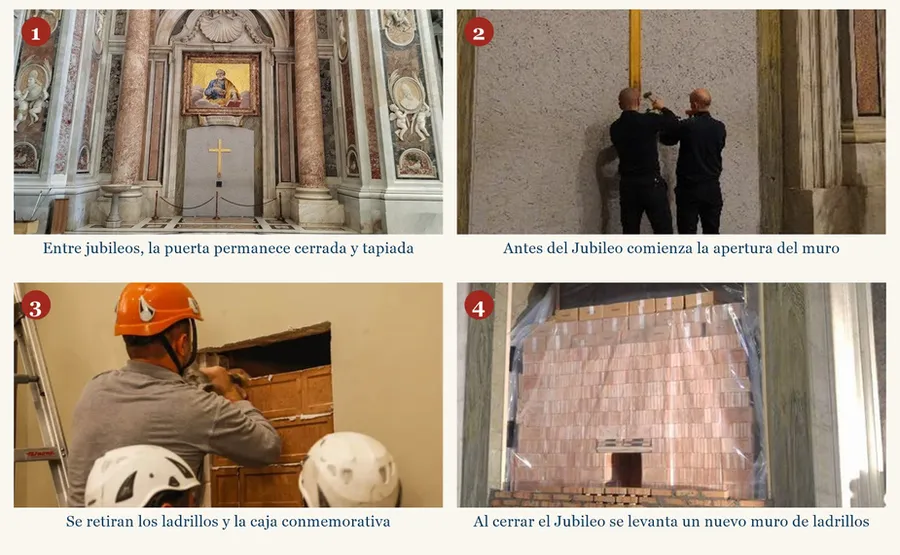
Between jubilees, the Holy Door stays closed and, on the inside, walled up with a wall of bricks.
Before the Jubilee begins, that wall is knocked down; inside is a metal box containing the parchment that certified the previous closing, medals and commemorative bricks. Then the Pope, or a cardinal on his behalf, solemnly opens the door.
During the Holy Year, millions of pilgrims pass through the door.
When the Jubilee ends the door is closed and a new wall is built with bricks made especially for the occasion; to close the Holy Door of St Peter's after the Jubilee of Hope, nearly 3,200 bricks were used.
This is what the process looks like, and below, each of our relics:
Relic of the Apostle James
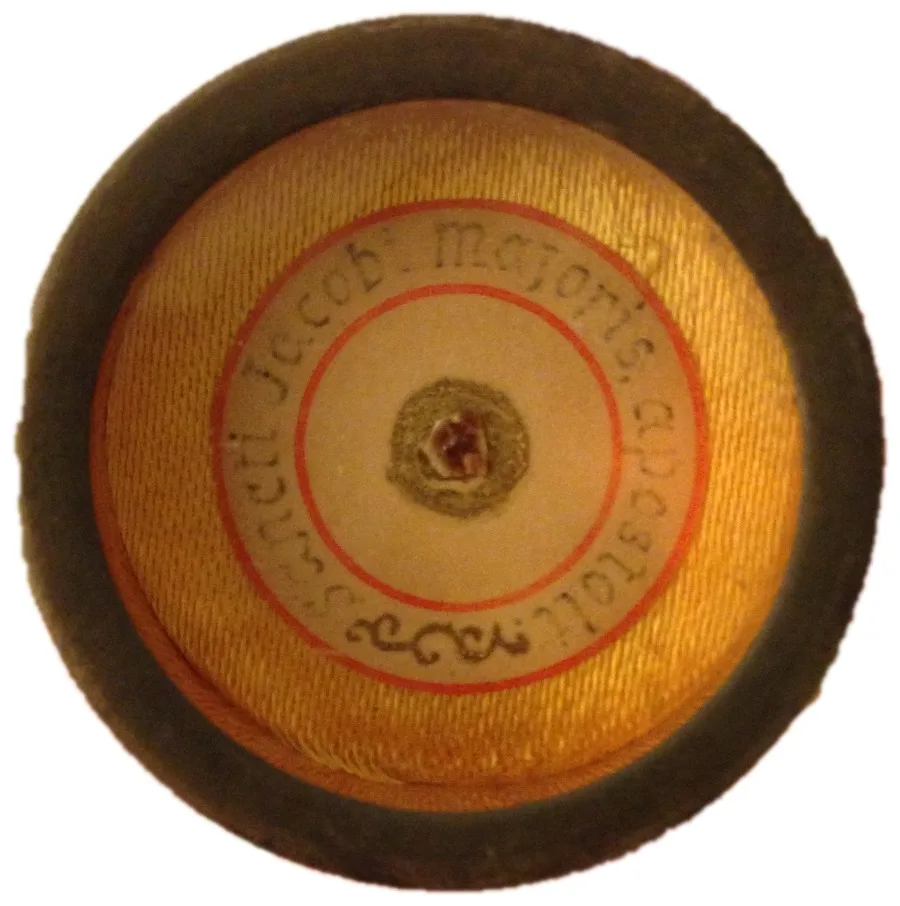
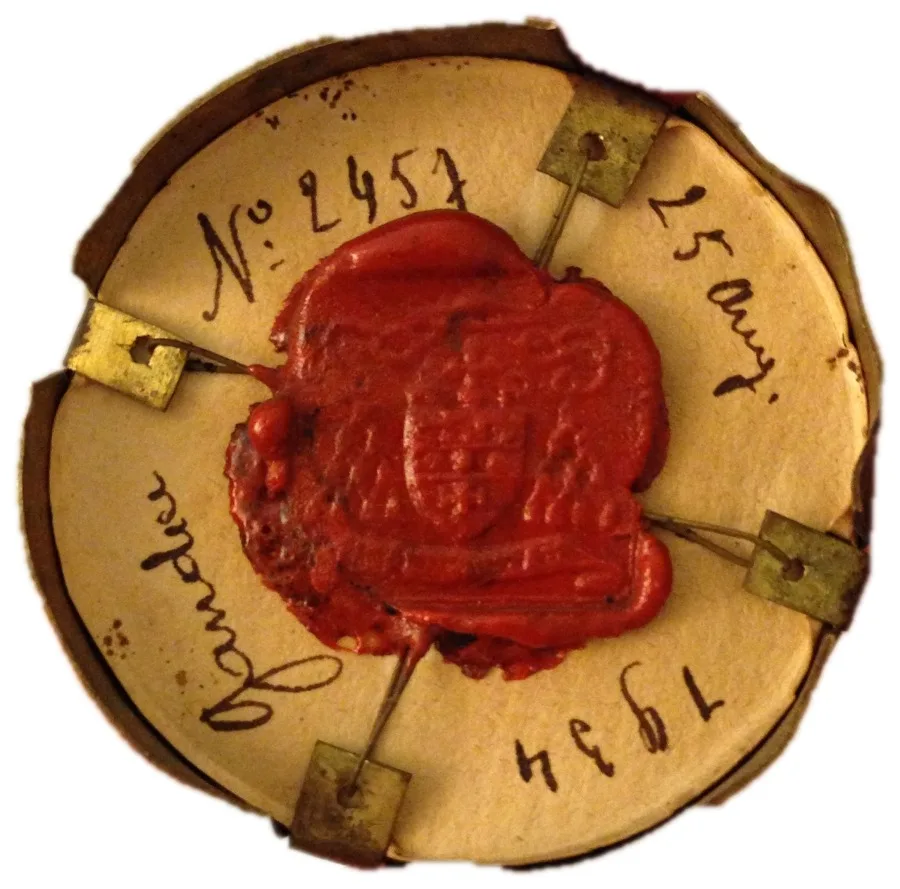
First-class relic (bone) of the Apostle. In 1056 King Ferdinand I of León gave James's right forearm to the monks of the abbey of Saint-Jacques in Liège (Belgium).
Our relic comes from the one kept in the Diocese of Ghent, certified by its bishop, Msgr Honoré Jozef Coppieters, on 25 August 1934 (No. 2457), and authenticated again in 2014. It is kept in a reliquary with the inscription "Sancti Jacobi majoris apostoli", sealed on the back with wax.
Stone from Compostela
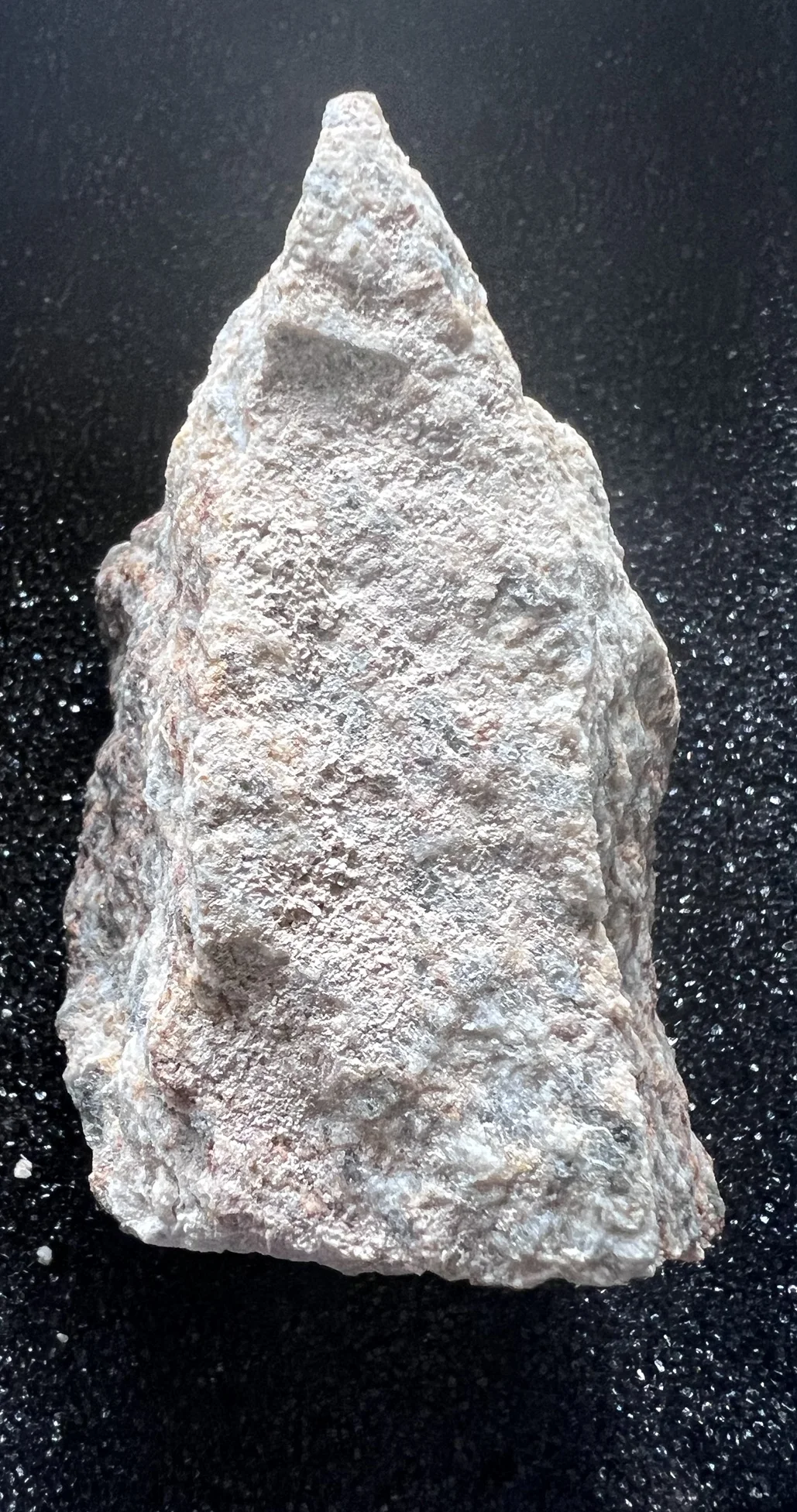
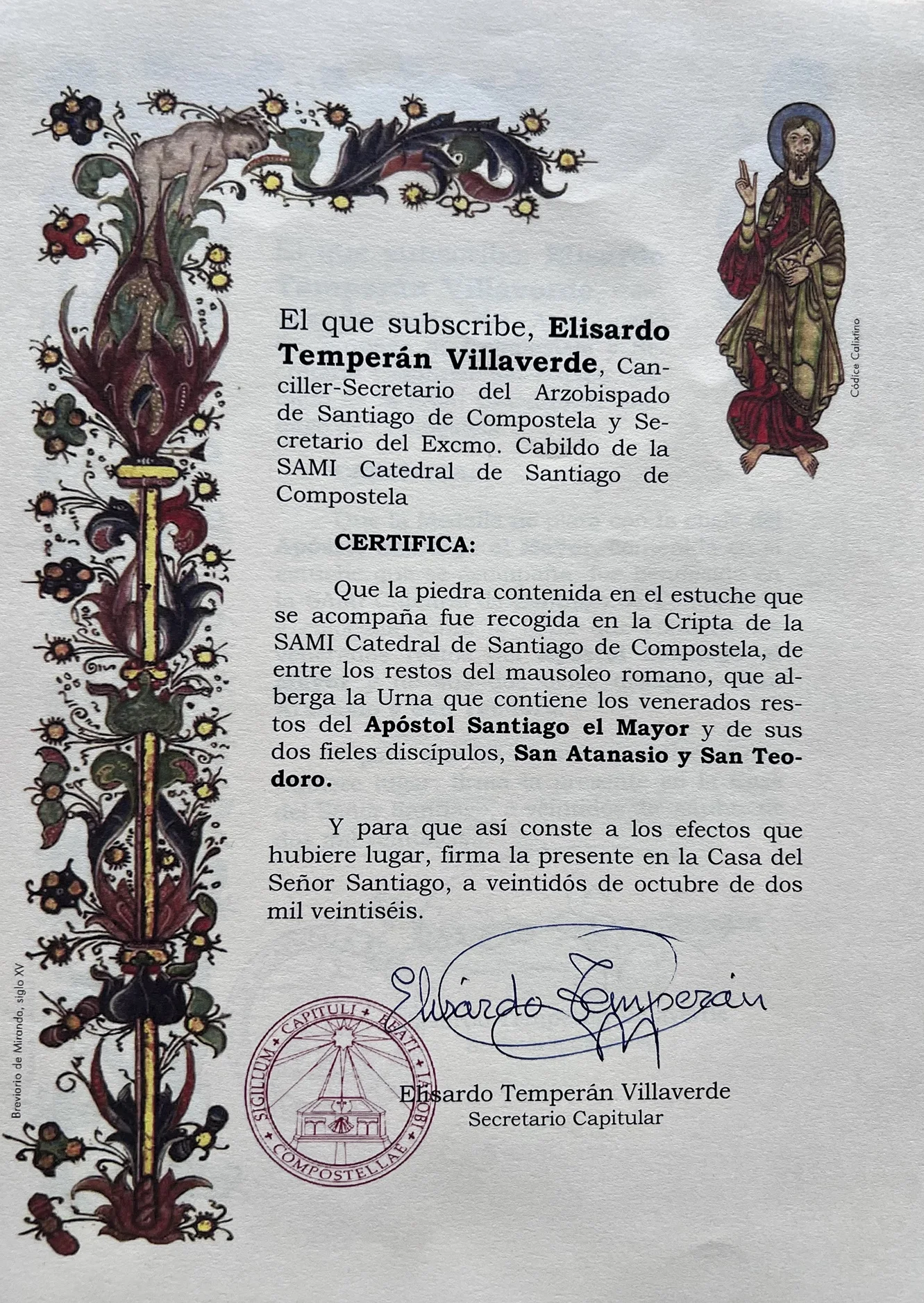
It was collected in the crypt of the Cathedral of Santiago de Compostela, from among the remains of the Roman mausoleum that holds the urn with the remains of Saint James the Greater and of his disciples Saint Athanasius and Saint Theodore.
This is certified by the Chapter of the Cathedral in a document signed by its chapter secretary, Elisardo Temperán Villaverde, on 22 October 2026. On 29 October 2026 the Archbishop of Compostela, Msgr.
Francisco José Prieto Fernández, handed it to Fr. Javier Vergara, parish priest of the Inmaculada Concepción Parish in Vitacura, for the relics of the Vía de los Andes.
Stone of the Holy Sepulchre
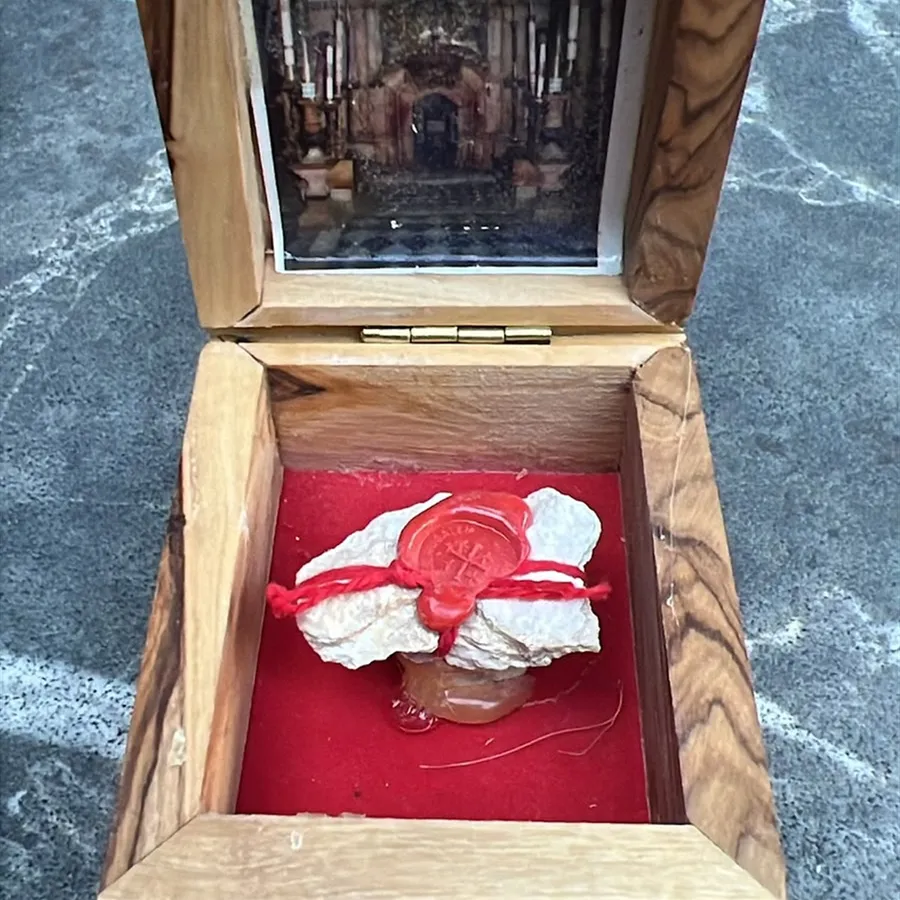
A fragment of stone from the Holy Sepulchre in Jerusalem, the place of Christ's burial and resurrection. It is a gift to the Vía de los Andes from the Franciscans of the Custody of the Holy Land, guardians of the Holy Places since 1342.
It is kept in a case made of olive wood from the Holy Land, tied with a red cord and sealed with wax.
Basilica of Saint Peter
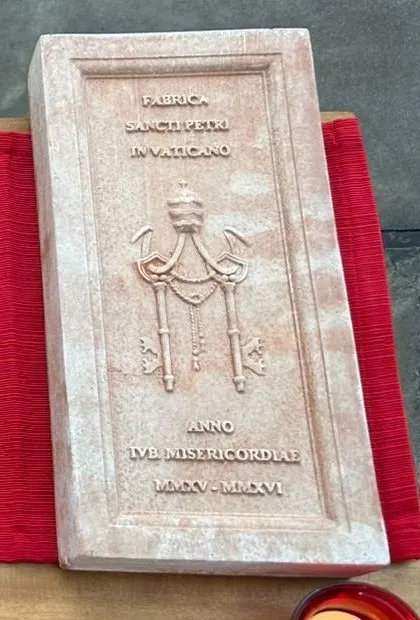
Built over the tomb of the Apostle Peter, in the Vatican, it is the heart of the Catholic Church. Its Holy Door was opened by Pope Francis on December 8, 2015.
Brick inscription: «Fabrica Sancti Petri in Vaticano · Anno Iub. Misericordiae MMXV–MMXVI», with the keys of Saint Peter and the papal umbraculum.
Basilica of Saint Paul Outside the Walls
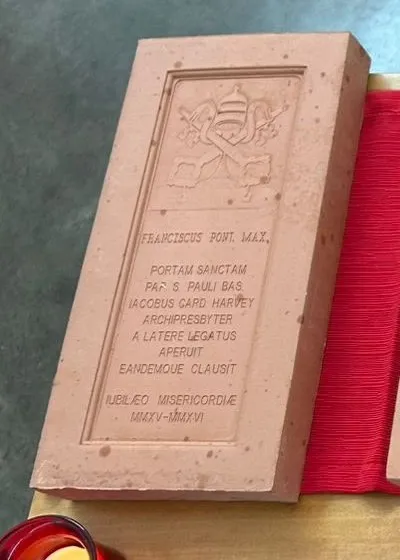
Built over the tomb of the Apostle Paul, outside the ancient walls of Rome.
According to the brick inscription, its Holy Door was opened and closed by Cardinal James Harvey, archpriest of the basilica and papal legate, during the Jubilee of Mercy (2015–2016).
For now the relics are not on display. To find out when they will be, write to us at peregrinos@caminosantiago.cl.
Basilica of Saint John Lateran
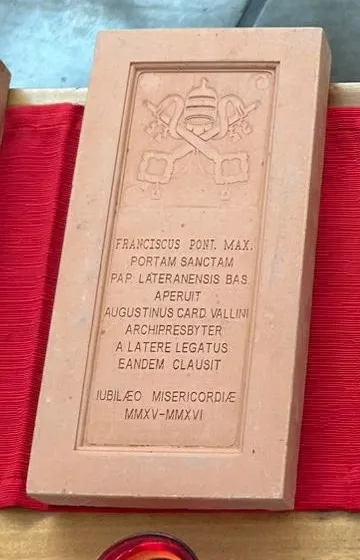
The cathedral of Rome and seat of the Pope as bishop of the city, it is called "mother and head of all the churches of the city and of the world".
According to the brick inscription, its Holy Door was opened by Pope Francis and closed by Cardinal Agostino Vallini, archpriest of the basilica and papal legate.
Basilica of Saint Mary Major
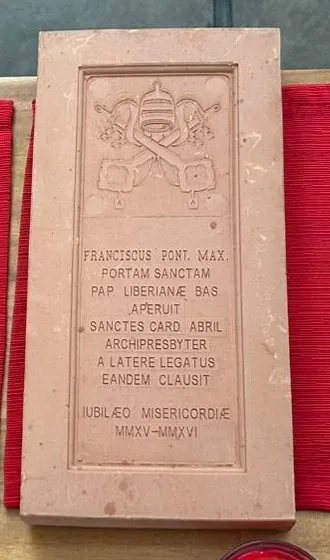
The oldest of the churches dedicated to the Virgin Mary in the West, also called the Liberian Basilica. Pope Francis now rests there.
According to the brick inscription, its Holy Door was opened by Pope Francis and closed by Cardinal Santos Abril, archpriest of the basilica and papal legate.
Blessing from the Archbishop of Santiago de Compostela
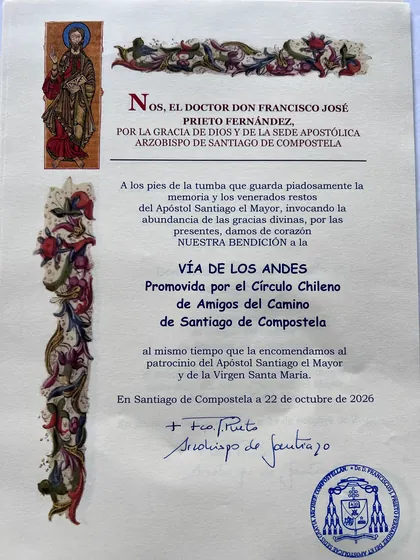
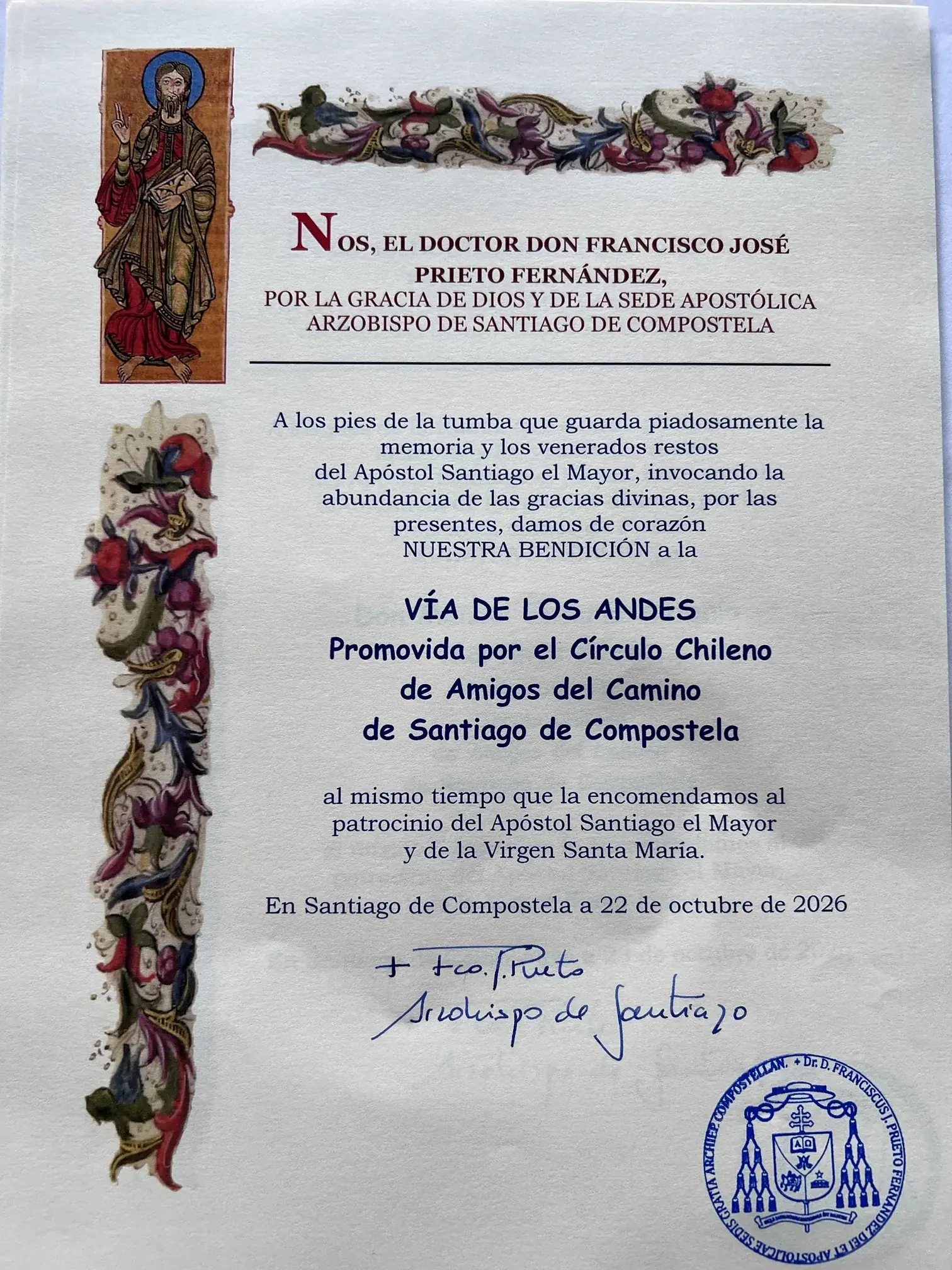
On 22 October 2026, Archbishop Francisco José Prieto Fernández of Santiago de Compostela gave his blessing to the Vía de los Andes, entrusting it to the patronage of Saint James the Greater and the Virgin Mary.
View the document full size
Institutions of the Vía de los Andes
The churches and places along the route, by municipality. Tap one to see its history, opening hours, services and stamp. The "Open" and "Closed" labels are calculated using Chilean time and the hours each church provided; please confirm before you set out.
The Centro Cultural de España, the Hito and Vitacentro have no physical stamp: you stamp them with the Mi Credencial app.
Santiago
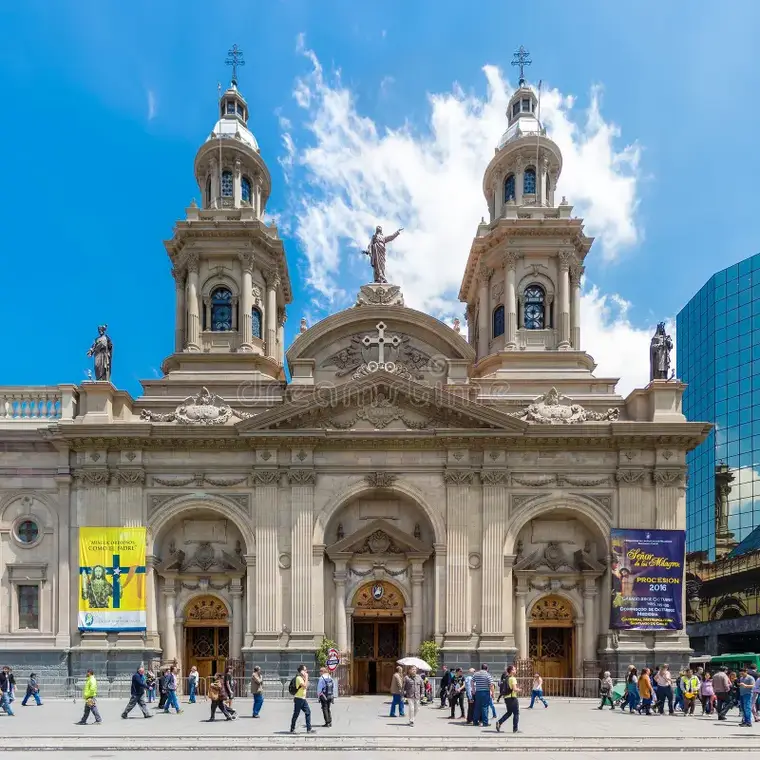 1Santiago CathedralPlaza de Armas, SantiagoMore information →
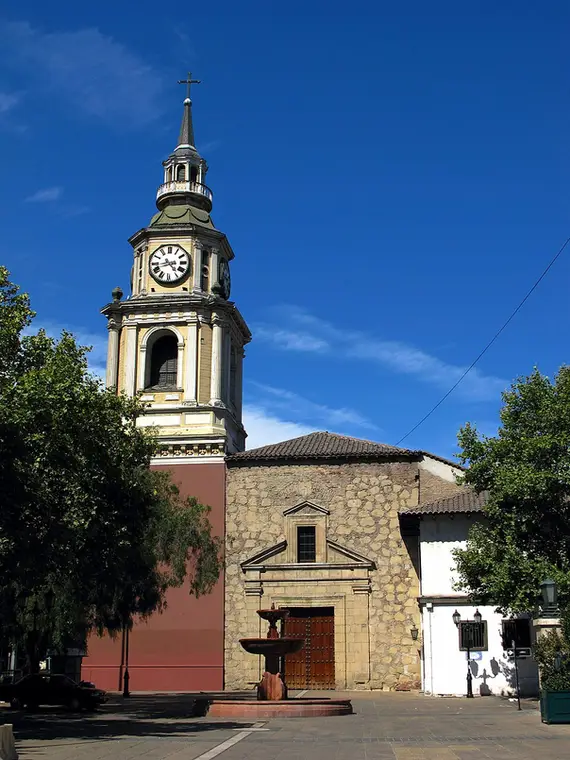 2Parish of San Francisco de la AlamedaAlameda 834, SantiagoMore information →
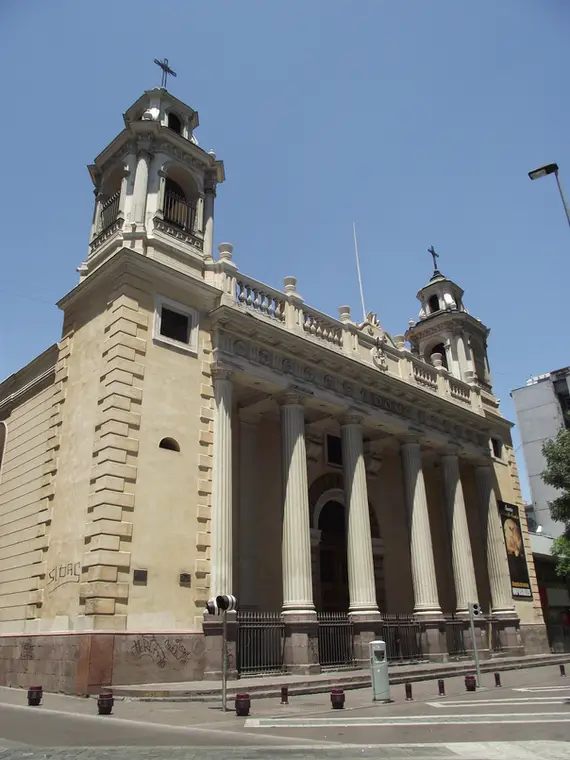 3Church of San AgustínPaseo Estado 185, SantiagoMore information →
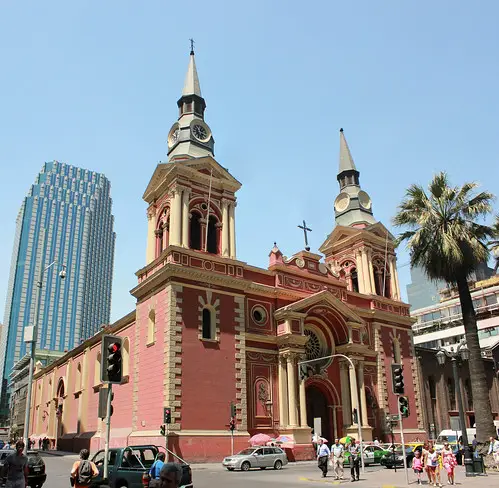 4Basilica of La MercedMac Iver 341, SantiagoMore information →
Providencia
 5Parish of the Holy Guardian AngelsRodolfo Vergara 0252, ProvidenciaMore information →
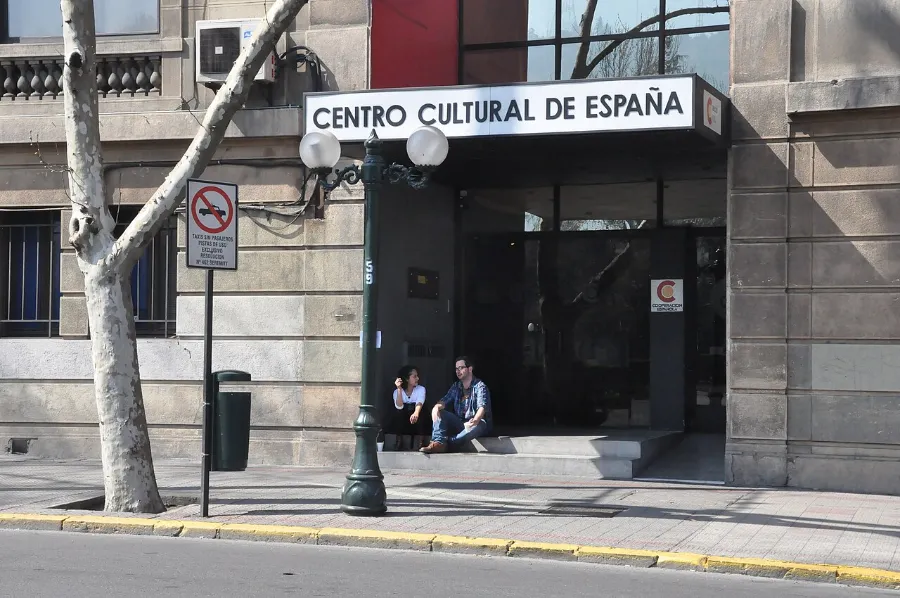 6Spanish Cultural CenterAv. Providencia 927, ProvidenciaMore information →
Vitacura
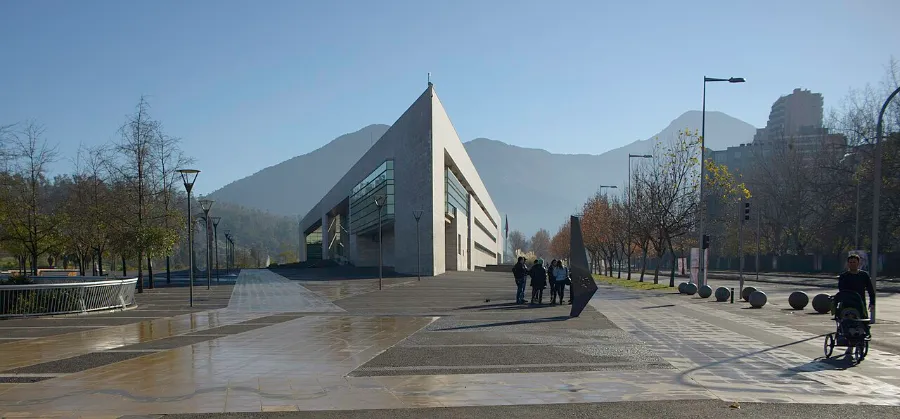 7Vitacura City Hall and Parque BicentenarioAv. Bicentenario 3800, VitacuraMore information →
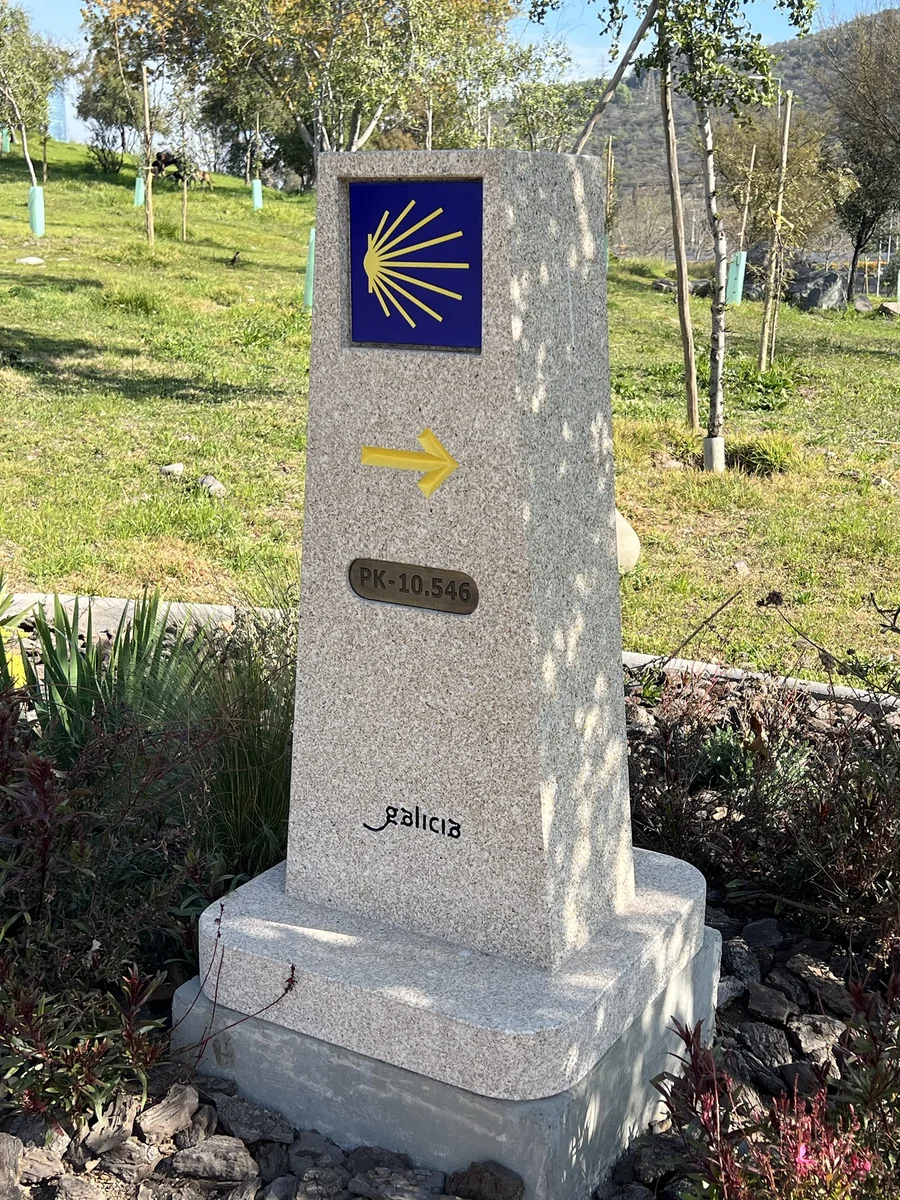 8National Monument: Milestone of the Camino de SantiagoParque Bicentenario, Av. Bicentenario 3800, VitacuraMore information →
 12VitacentroLas Tranqueras Oriente 2566, VitacuraMore information →
Las Condes
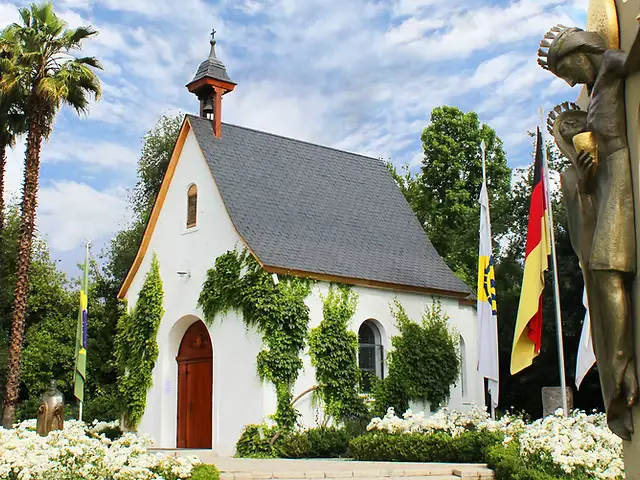 13Shrine of Schoenstatt in CampanarioCampanario 213, Las CondesMore information →
 14Parish of San Alberto HurtadoLa Parroquia 12108, Las CondesMore information →
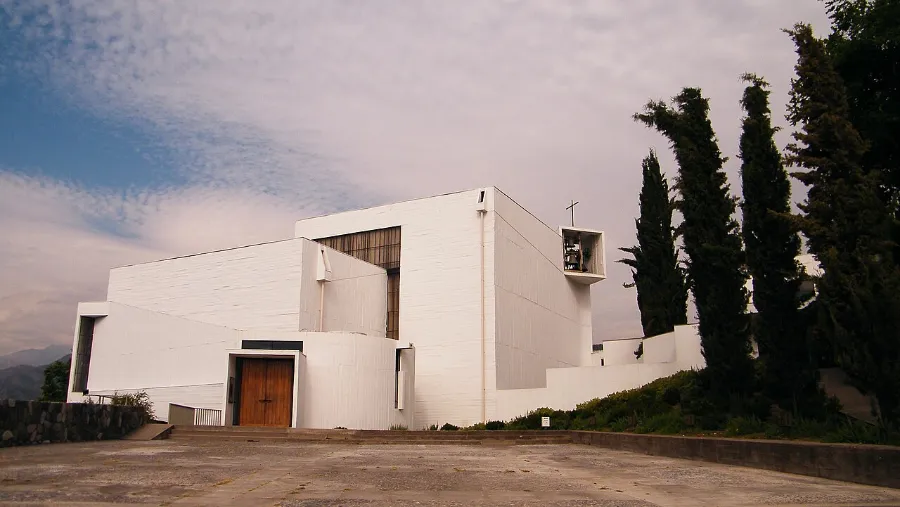 15Benedictine Monastery of the Most Holy TrinityMontecassino 960, Las CondesMore information →
Vitacura Parishes Variant
Three parishes in Vitacura that you can add to your route, between the Parque Bicentenario and Las Condes.
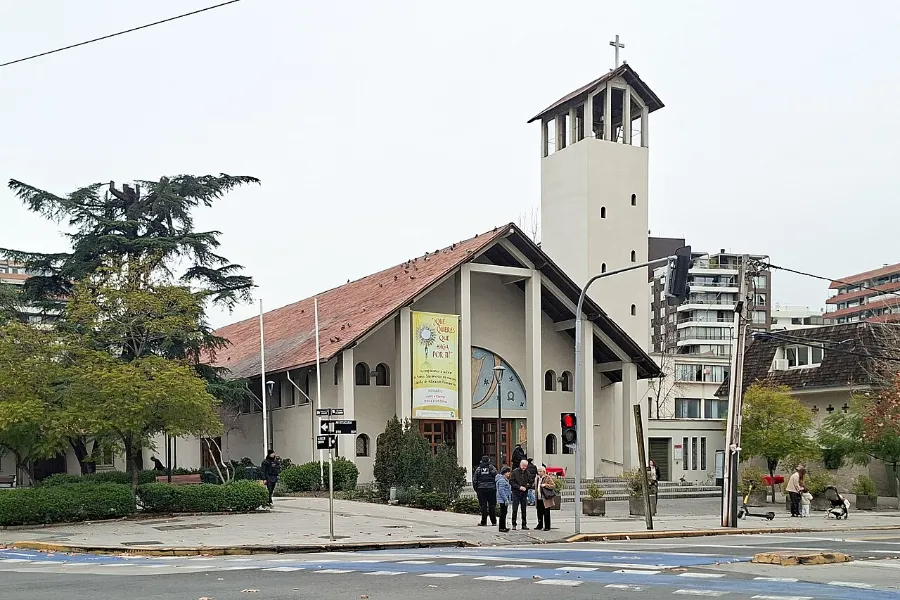 9Parish of the Immaculate ConceptionAv. Vitacura 3705, VitacuraMore information →
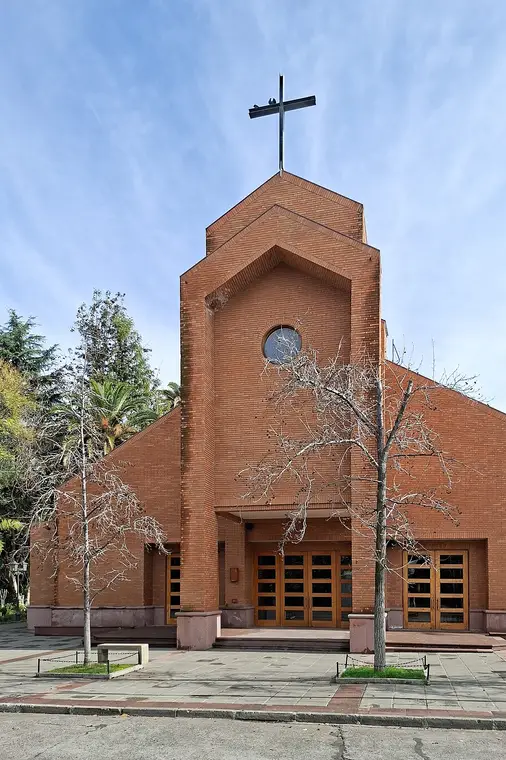 10Parish of Saint John the ApostleJacques Cazotte 5600, VitacuraMore information →
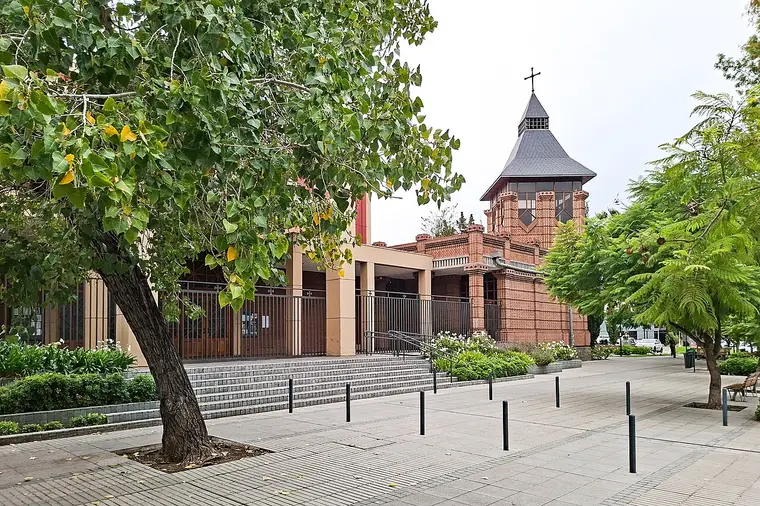 11Parish of Our Lady of Mercy, Los CastañosAv. Vitacura 7401, VitacuraMore information →
See the map with all the points Spiritual preparation
Anthem of the Vía de los Andes
Walking the Vía
On your own or in a group
Your pilgrimage, at your own pace: the route is open all year round.
You don't need to wait for a group pilgrimage to experience the Vía de los Andes. You can walk it alone, as a couple, with your family or with a group of friends. This guide explains how to prepare and how to get the stamps that validate your journey.
1. Before you set out
Get your pilgrim credential
Internal credential (free, valid in Chile only): it is handed out at any of the four starting parishes in the city center: the Metropolitan Cathedral, the Church of San Francisco de la Alameda, the Church of San Agustín or the Basilica de la Merced. You use it to record the stamps from your route.
Official Chilean Pilgrim Credential (dual): if you want to have your pilgrimage recognized and have your 25 km counted in Santiago de Compostela, request it through the pilgrim request form , before or after your walk. It costs $3,700 ($6,000 together with the Testimonium).
If you request it afterward, we give it to you with all the stamps from your internal pilgrim credential, valid for Spain.
Check the map
The route links 15 points in the municipalities of Santiago, Providencia, Vitacura and Las Condes, from the historic center to the Benedictine Monastery. See the map
Choose your day
- Each church has its own opening hours. Confirm the hours before you set out, especially for your starting church and the Benedictine Monastery (final stamp).
- Avoid days of extreme heat in summer or heavy rain in winter.
- If you are travelling to Spain and would like to receive the Pilgrim's Blessing, arrange it in advance.
2. How to plan your route
It is about 25 km. Walking at an easy pace, with stops to get stamps and rest, plan for a full day.
- In one day: set out early from one of the starting churches so that you reach the Benedictine Monastery in daylight.
- In two days (recommended if it is your first time or you are walking with children or older people): Day 1, Santiago and Providencia: from the churches in the center to Providencia and Vitacura (Parque Bicentenario). Day 2, Vitacura and Las Condes: from Vitacura to the Schoenstatt Shrine, the Parish of San Alberto Hurtado and the Benedictine Monastery. Pick up the next day exactly where you left off.
3. The stamps: the only essential thing
You need 4 stamps in your paper credential: one at the start, two intermediate ones and the Benedictines' stamp. If you also use the Mi Credencial app you need 5, because the digital stamp of the Hito is added.
The Centro Cultural de España, the Hito del Camino de Santiago and Vitacentro have no physical stamp: you stamp them with the Mi Credencial app. The Centro Cultural de España and Vitacentro also have restrooms.
If you walk alone
- Tell someone your plan for the day and share your live location.
- Carry your phone fully charged and, if you can, a power bank.
- Walk along main streets and busy parks; avoid carrying valuables in plain sight.
- Plan to arrive at the Benedictine Monastery in daylight.
Walking alone is also an opportunity for silence and prayer: make each church a pause for the spirit.
What to bring
- Your pilgrim credential, protected in a plastic bag.
- Comfortable, well-worn footwear (never new shoes).
- Water (at least 1.5 liters) and something to eat.
- Sunscreen, a hat and sunglasses.
- A light jacket or windbreaker.
- Your identity card and some cash.
- A charged phone and a small first-aid kit.
If you walk in a small group
For groups of 2 to 10 people:
- Agree on a common pace: let the slowest person set the speed.
- Appoint a coordinator who carries the map, the opening hours and a small first-aid kit.
- Agree on meeting points at each church or park.
- When you arrive at each church, go in quietly and in an orderly way: many are holding Mass or prayer.
If you are more than 10 people or want to coordinate your visit to the churches, write to us.
When you finish
With all your stamps (4 with the paper credential, 5 if you also use the digital one) you will receive the final stamp, which certifies your pilgrimage along the Vía de los Andes.
The internal pilgrim credential (white) is for use in Chile only. If you want to have your 25 km counted in Santiago de Compostela, request the official Chilean Pilgrim Credential (blue) through the pilgrim request form , before or after you walk: if you request it afterward, we give it to you with all the stamps from your internal pilgrim credential.
With your 25 km recognized, you will only need 75 km in Spain to complete the minimum of 100 km and obtain the Compostela.
Do you have questions? Write to us at peregrinos@caminosantiago.cl and we will help you prepare your pilgrimage. Buen Camino!
Before you set out: pilgrim credential, symbols and safety
What the Pilgrim Credential says, the symbols of the Vía and emergency phone numbers.
This guide brings together what the official Pilgrim Credential says and what the Mi Credencial app already explains, so you have everything before you start walking.
A support credential
The digital pilgrim credential is a complement to the official physical credential, which remains the only one valid for certification. It serves two purposes: support along the route, with a map, stages and points of interest, and a backup for stamping, to record your passage when there is no one to stamp the physical credential. The physical credential must be stamped at the authorized points whenever possible.
Prior considerations
What the Pilgrim Credential (2025 edition) says:
- It is intended exclusively for those who make the pilgrimage on foot, by bicycle or on horseback, with a Christian sense, even if this is expressed as an attitude of inner searching.
- Its main purpose is to identify the pilgrim, without implying the acquisition of any rights, but as a sign of spiritual commitment.
- It serves two practical purposes: to facilitate access to the hostels that offer Christian hospitality along the Camino, and to certify the pilgrim's passage, in order to request the Compostela at the Cathedral of Santiago.
- The Compostela is granted only to those who have made the pilgrimage with a Christian sense and have reached the Tomb of the Apostle Saint James, having covered at least 100 continuous km on foot or on horseback, 200 km by bicycle, or 100 nautical miles, completing the final stretch on foot, always in the direction of Santiago.
- Those who begin their pilgrimage in Chile and complete the Vía de los Andes (25 km) must also cover a minimum of 75 continuous kilometers in Spanish territory, following any of the routes officially recognized by the Cathedral of Santiago.
- To meet the total distance requirement, the last stage must be, at a minimum, the one directly before arrival at the Cathedral. The journey must be certified with at least two stamps per day, with their date, in accordance with the rules for obtaining the Compostela.
- The Pilgrim Credential can only be issued by the Church, directly or through entities authorized by it. This is the case of the Círculo Chileno, whose Chilean Pilgrim Credential was officially recognized by the Cathedral of Santiago on June 23, 2025.
- The Vía de los Andes was recognized as an official route by the Cathedral of Santiago on September 22, 2025.
- The bearer of the credential accepts these conditions.
Symbols and their meaning
- Ink stamp: there is a physical stamp for your paper credential. Ask the sacristan or the parish office; if they don't know how to help, keep asking or speak with the parish priest so they stamp it for you.
- Digital stamp: you record your passage with GPS or the QR code in the app. If a point has both, you will see both circles; if it only has the blue one, there is no physical stamp.
- Masses: the times are in each point's page .
- Restrooms, water, rest and cafeteria: these are indicated at each point.
- Opening hours: they may change, so it is best to check them before you go.
- Accessibility: all the points on the Vía are accessible.
Emergency phone numbers
In Chile they are free from any phone.
- 131: ambulance.
- 132: fire department.
- 133: Carabineros.
Municipal security, depending on the municipality: Santiago 1406 , Providencia 1414 , Vitacura 1403 and Las Condes 1402 .
Before you set out
- Check the forecast: the app shows the weather for the four municipalities and warns you if there is rain or very high UV radiation.
- Follow the map in the app; the blue tiles with the scallop shell have not been installed yet.
- Bring water, sunscreen, a hat and a rain jacket, and protect your documents if it rains.
- You can notify a trusted contact: the app sends them an email with your location when you stamp a point or when you ask it to.
Chilean pilgrim credential
The two paper credentials of the Vía and their recognition in Spain.
- Internal credential: it is free and valid in Chile only. You request it at any of the four starting churches and record your stamps in it. It is not valid in Spain.
- Chilean Pilgrim Credential (dual): the official one. It is valid on the Vía de los Andes and on the Camino in Spain, and it is the only one that validates the 25 km in Santiago de Compostela.
Validation and stamps
Minimum stamps, final stamp and Certificate of Distance.
Stamps are recorded in your paper credential: the internal one, if you will only walk the Vía in Chile, or the Chilean Pilgrim Credential (dual), which is the official one and the only one that validates the 25 km in Compostela.
Minimum stamps
To validate your pilgrimage you need these stamps:
- One starting stamp at any of the four starting churches: the Metropolitan Cathedral, San Francisco de la Alameda, San Agustín or the Basilica de la Merced.
- Two intermediate stamps at any of the authorized points along the route.
- One stamp from the Benedictines (Benedictine Monastery of Las Condes), which certifies the completion of the pilgrimage.
If you use only the paper credential, these 4 stamps are enough.
If you also use the digital credential (Mi Credencial), you need 5 stamps: the 4 above plus the digital stamp of the Hito del Camino de Santiago en Chile, in Parque Bicentenario. This stamp can only be obtained with the app, by arriving at the monument.
The paper credential remains the official one. The digital one is a support for stamping where there is no one to do it.
Final stamp
Once the minimum requirements are met, the final stamp is placed on your credential, at the Benedictine Monastery or at the offices of the Círculo.
In Compostela
With the dual credential you validate the 25 km of the Vía and only need to walk 75 km in Spain to obtain the Compostela. The Certificate of Distance, issued by the Cathedral, certifies both stretches.
The Vía in Compostela
How your 25 km in Chile are added when you arrive in Santiago de Compostela.
If you walked the Vía de los Andes
In the Pilgrim's Office registration, enter the Vía de los Andes as the Camino you walked and Santiago de Chile as your starting point . Your 25 km in Chile are added, and in Spain you are asked for 75 km. The steps and the certificate of distance are below.
If you did not walk the Vía de los Andes
Complete the registration with the details of your Camino in Spain, like any pilgrim: see the steps in Registration and Compostela . You can walk the Vía whenever you like, before you travel or when you return.
Build your Camino with the Vía de los Andes
The 25 km of the Vía de los Andes are added to the kilometers you walk in Galicia to complete your Compostela. Choose your Camino and we suggest an approximate starting point; distances are approximate.
Registration at the Pilgrim's Office
On the registration form, enter the Vía de los Andes as the Camino completed, not the Spanish Camino, and Santiago de Chile as your starting point. This way the Cathedral records that you set out from Chile. What you present at the Pilgrim's Office:
- Bring your official Chilean Pilgrim's Credential (dual), with the stamps of the Vía de los Andes, in addition to the stamps of your Camino in Spain.
- At the Office, show the stamps of the Vía: the Cathedral Chapter recognizes those 25 km as part of the Camino.
- Ask for the distance certificate: a single document stating that you started from Santiago de Chile, adding the 25 km of the Vía to your total, and recording that you walked the Spanish Camino you chose plus the Vía de los Andes.
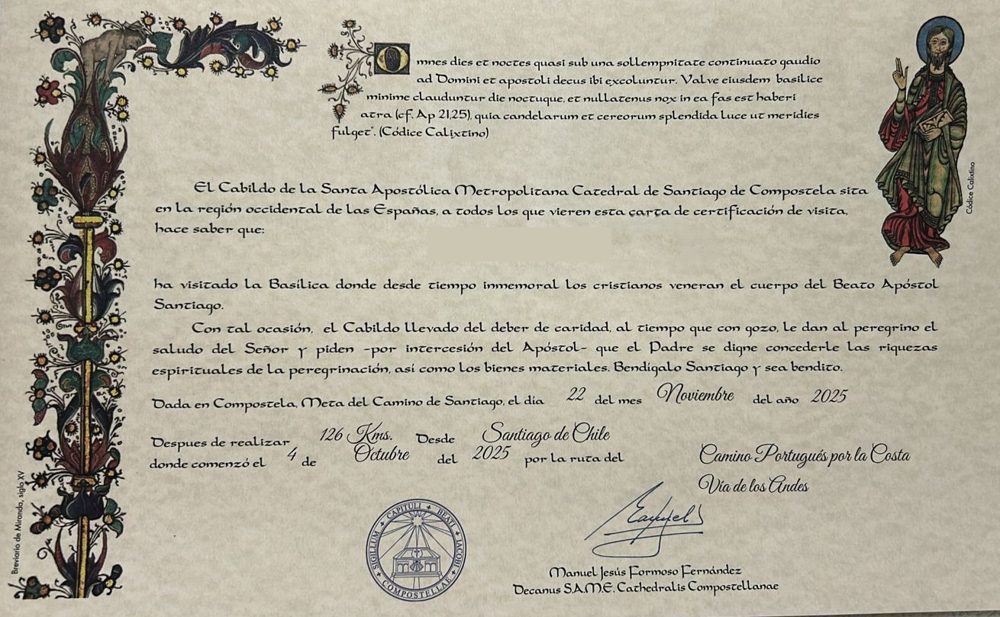
The certificate shows the place in Chile where you started (for example Santiago de Chile or San Agustín), the total kilometers with the 25 of the Vía included, the start date and, as the route, the Spanish Camino you chose together with the Vía de los Andes.
If you do not yet have the official credential, request it through the pilgrim request form ($3,700). If you request it after walking, we will deliver it to you with all the stamps from your internal credential.
Benefits of walking the Vía de los Andes
- Only 75 km in Spain: the 25 km from Santiago de Chile are recognized as Camino, so in Spain you only need 75 km to reach the 100 km minimum for the Compostela.
- Distance certificate: a single document stating that you started from Santiago de Chile, adding the 25 km, and recording the Spanish Camino chosen plus the Vía de los Andes.
- Testimonium Peregrinationis: the official certificate of the Vía de los Andes, with the stamps of churches, municipalities and monuments.
- Preparation for the Camino: you do it in your own city, at your own pace, alone or in a group, and you receive the Pilgrim's Blessing.
- Community: you walk with other pilgrims and with the support of the Círculo.
The form is completed on the Pilgrim's Office website, which is the entity that keeps your data. If you have questions about which options to choose, write to us at peregrinos@caminosantiago.cl .
Pilgrim's Blessing
A rite of protection and guidance before setting out on the Camino.
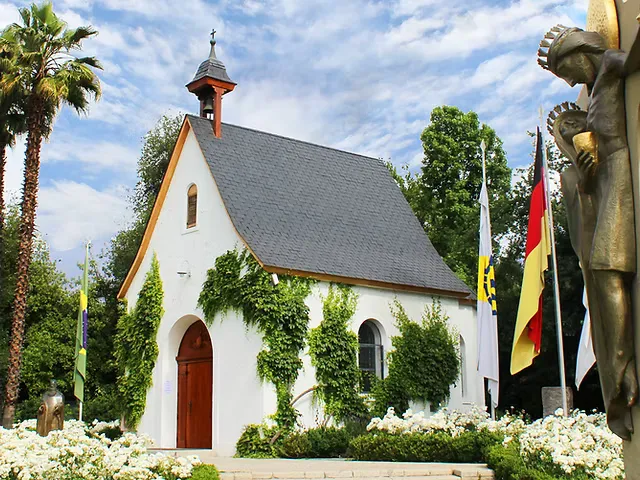
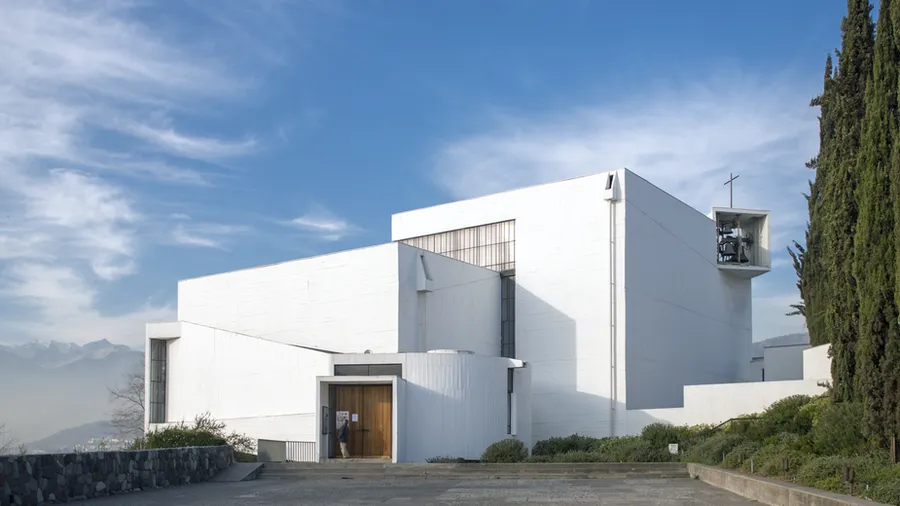
The pilgrim's blessing is for those who are going to walk the Camino de Santiago in Spain. It is received at the Schoenstatt Shrine in Campanario or at the Benedictine Monastery, and is arranged in advance.
If you only walk the Vía de los Andes, a blessing may be given at the churches along the route, depending on the priest's availability. More about the blessing
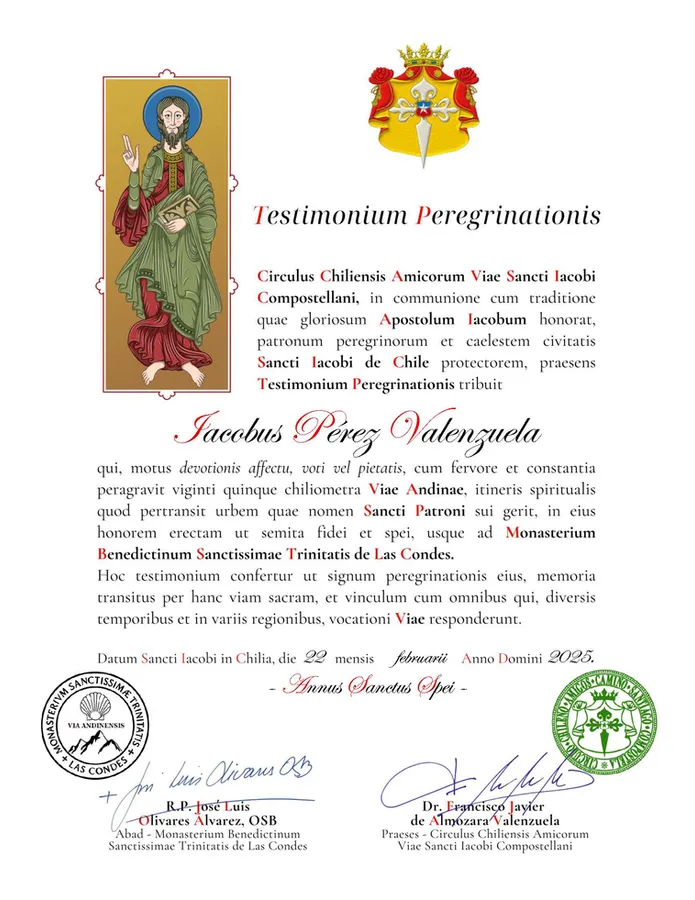
Testimonium Peregrinationis
The official document certifying completion of the Vía de los Andes.
The Testimonium Peregrinationis certifies completion of the Vía de los Andes, the Chilean section of the Camino de Santiago, a Christian, spiritual and cultural route. It is granted to those who complete the route with inner purpose, a commitment to heritage, and respect for the values of hospitality, prayer and transcendence of the Jacobean tradition.
The pilgrimage may begin at any of the four historic churches in central Santiago: the Metropolitan Cathedral, the Church of San Francisco de la Alameda, the Church of San Agustín or the Basilica of La Merced.
At any of them you can request the Pilgrim's Credential free of charge, where the stamps of your progress will be recorded. There you also collect your credential and receive the first stamp.
If a priest is available, he may give you a blessing; the pilgrim's blessing for those travelling to Spain is explained on its own page.
To obtain the Testimonium
- Begin your journey at one of the four churches mentioned, collecting your credential and receiving the first stamp.
- Collect the minimum stamps: 4 with the paper credential or 5 if you also use the app.
- Complete the pilgrimage at the Benedictine Monastery of Las Condes, where the final stamp is granted and, if applicable, the Testimonium Peregrinationis.
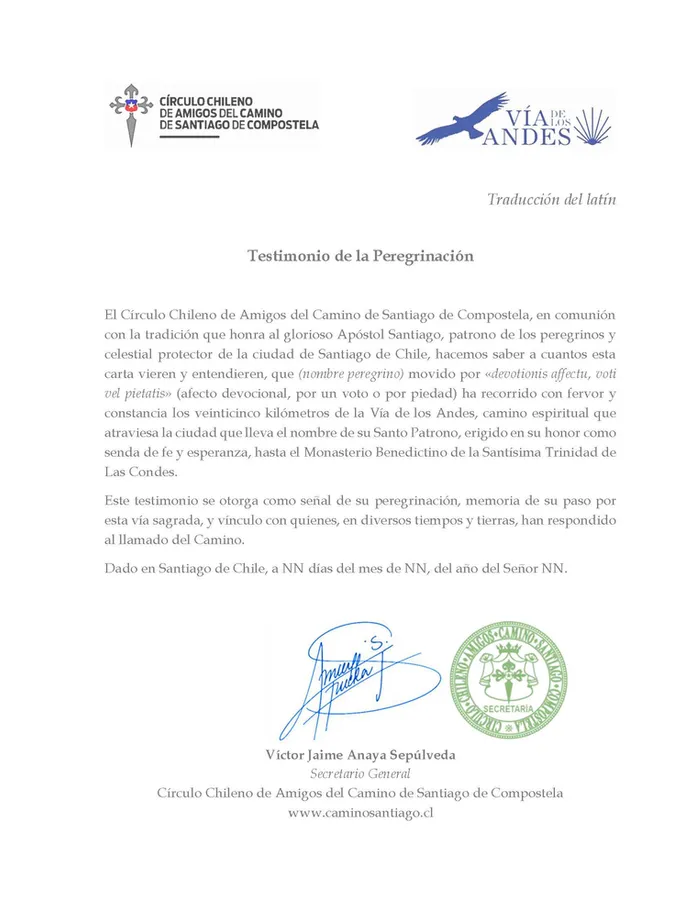
This document symbolizes the effort, devotion and spiritual connection of the pilgrim with the Vía de los Andes, and forms part of the recognition of the Camino de Santiago in the Americas.
Vía de los Andes tile (loseta)
The tile (loseta) is the same piece that will mark the route on the ground along the Vía de los Andes. It is a handmade, numbered piece, 20 × 20 cm, and comes with its certificate of authenticity. It costs $19,000, and by buying it you help fund the installation of tiles on the streets along the route.
It is requested through the pilgrim request form and picked up at our office at San Félix 1318, Vitacura (pedestrian entrance via Las Hualtatas), on Wednesdays from 5 to 7 p.m.
How to request and pay
Everything is requested through a single form, “Pilgrim Requests” (Solicitudes del Peregrino). You can request one or several items in the same request.
- Testimonium Peregrinationis: $3,700.
- Chilean Pilgrim's Credential (for those who will walk or continue the Camino in Spain): $3,700.
- Testimonium and credential together: $6,000.
- Vía de los Andes tile: $19,000.
Payment: by bank transfer to Círculo Chileno de Amigos del Camino de Santiago · BancoEstado · Checking Account (Cuenta Vista) No. 279-7-003858-8 · tesorero@caminosantiago.cl . If you request both the Testimonium and the credential, make a single transfer of $6,000. The form asks for the receipt.
Pickup: Wednesdays from 5:00 to 7:00 p.m. · San Félix 1318, Vitacura (pedestrian entrance via Las Hualtatas).
If you use the Mi Credencial app, you can also request them from there, at the same prices.
Supporting institutions
The Vía de los Andes, as a project of the Círculo Chileno de Amigos del Camino de Santiago, works together with the municipalities of Santiago, Providencia, Vitacura and Las Condes, the Metropolitan Regional Government of Santiago, the Archdiocese of Santiago de Chile and that of Compostela, and the Embassy of Spain, as well as various parishes. This strengthens its spiritual, cultural and community dimension.
The Círculo's app guides you to the next point and lets you stamp by GPS or QR code when no one is there to stamp your physical pilgrim credential. It saves your stamps even when you have no signal.
Frequently asked questions about the Vía de los Andes
What is the Vía de los Andes?
It is the Camino de Santiago in Chile: a spiritual, cultural and community route linking churches and spaces in Santiago, Providencia, Vitacura and Las Condes, and connecting the heart of Chile with the Camino in Spain.
How many kilometres and stops does it have?
It is 25 km with 15 points in four municipalities, from Santiago Cathedral to the Benedictine Monastery of Las Condes.
Since when is it an official stretch of the Camino?
Since 22 September 2025. It began that year, promoted by the Círculo Chileno de Amigos del Camino de Santiago, following an invitation from Santiago de Compostela Cathedral.
How do I validate my kilometres?
With your credential stamped at the points of the Vía. The paper credential is the official one; the Mi Credencial app supports it with a GPS or QR stamp when nobody is there to stamp. Three places (Centro Cultural de España, Hito del Camino de Santiago and Vitacentro) have no physical stamp: you stamp them with the Mi Credencial app.
Do the 25 km count towards the Compostela?
Yes. Pilgrims who complete the Vía with a stamped credential can count those 25 km as Camino, and in Spain they need 75 km instead of 100 for the Compostela.
